I saw Cage out of the cage!
Homage to John Cage for an ensemble of ten toy pianos
Rituality and Minimalism: A dialogue between ten small pianos in the name of Cage
The Legacy of John Cage: Dignity in Small Sound
John Cage was the pioneer who dismantled the boundaries between sound and noise, elevating everyday objects and "toy" instruments to concert dignity.
His 1948 Suite for Toy Piano was a landmark where the limited timbral possibilities and reduced range of the tiny instrument were used to create an aesthetic of essentiality.
Cage saw the toy piano not as a limitation, but as a liberation from the weight of Romantic tradition: a pure, percussive sound, free of vibrato, that forces the composer to focus on structure and rhythm.

I saw Cage out of the cage!: An Architecture for Ten Toy Pianos
This work is a suite in four movements that reimagines the Cagean spirit through a contemporary and collective lens:
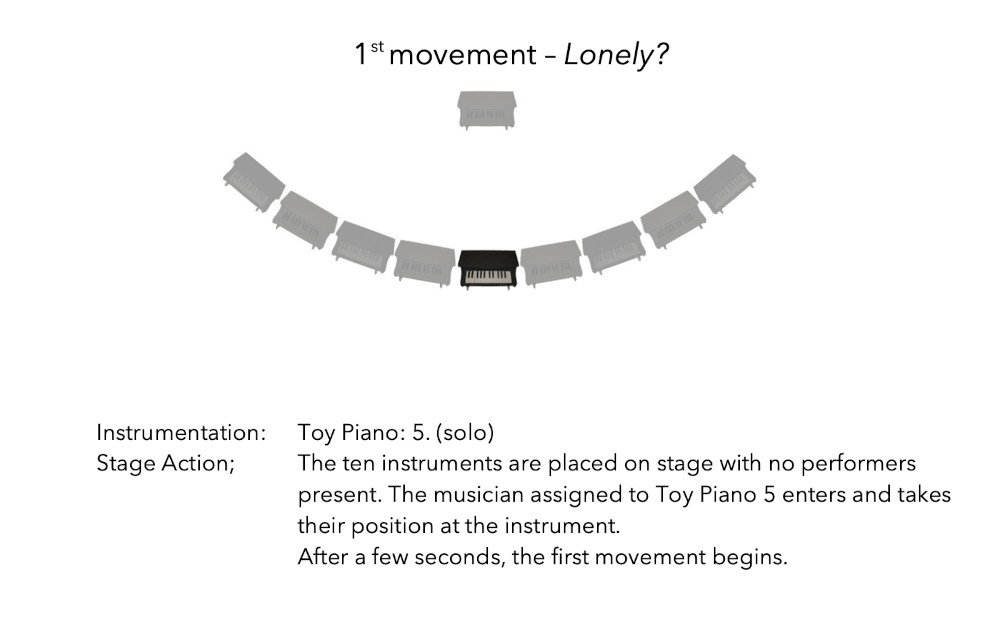
Lonely?
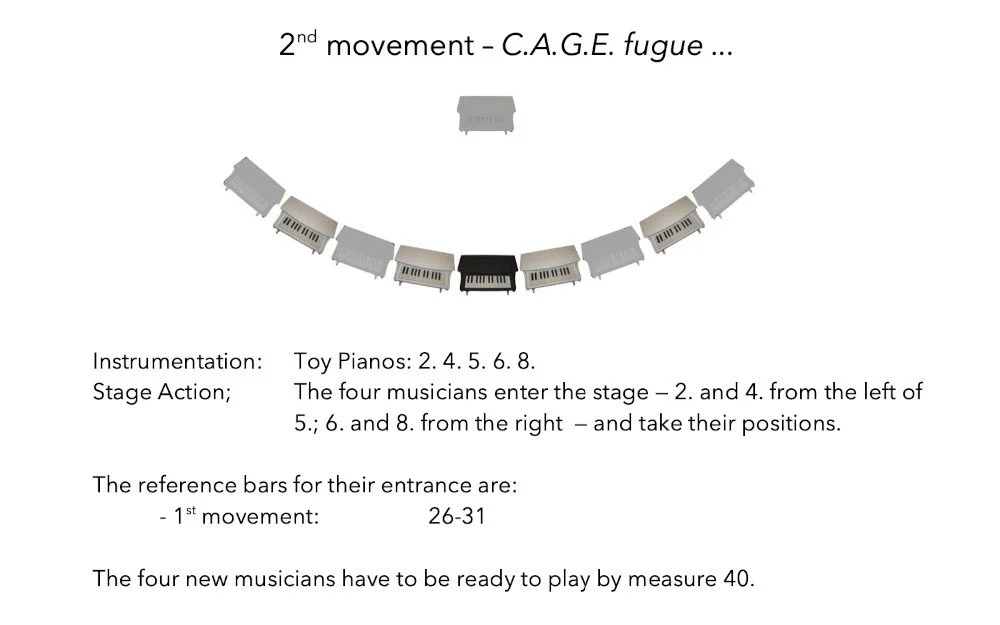
C.A.G.E. fugue..
.. to the beach
Everybody!
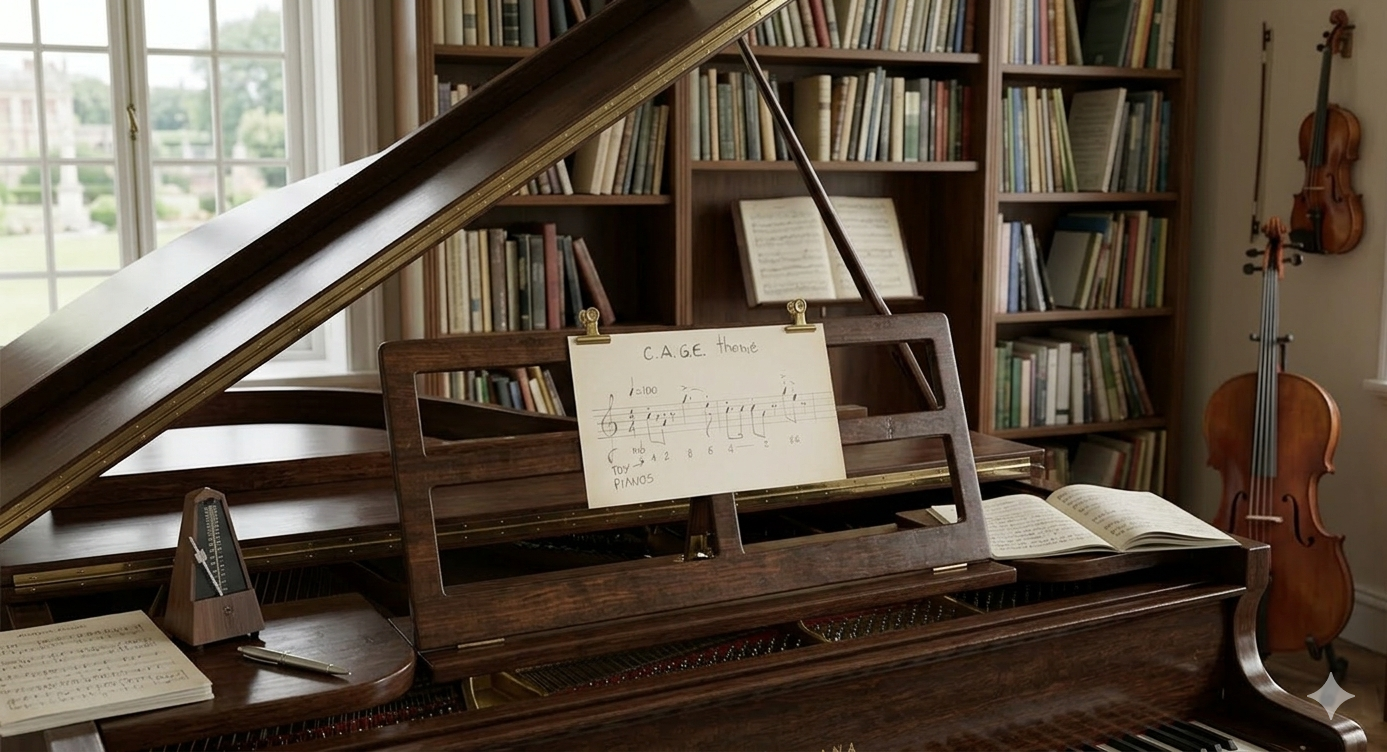
The title—a play on the composer’s name and the concept of a "cage"—suggests a release from academic conventions. The composition is built around the nominal theme C.A.G.E. (C-A-G-E), serving as the generating cell for the entire work. Utilizing ten 25-key toy pianos (Schoenhut models), the suite explores varying sonic densities: from the solipsistic introspection of the first movement to the rhythmic saturation of the last, creating a unique timbral mosaic where the fragility of a single instrument acquires unexpected orchestral power.
Performance and Rituality: The Movement of Musicians
A distinctive element of the suite is its choreographic and performative nature.
The execution does not require a conductor, entrusting the pulse and metronomic timing to the fifth toy piano—the ensemble’s beating heart. The performance is conceived as a process of silent accumulation: the four movements are played without pause, while musicians take their places at their instruments gradually and discreetly. This physical movement is an integral part of the score, transforming the act of "taking a seat" into a ritual gesture.
The sonic journey culminates in an extreme performative act: the simultaneous overturning of the toy pianos to strike all keys at once, generating a sound explosion that dissolves the thematic structure into pure resonance.
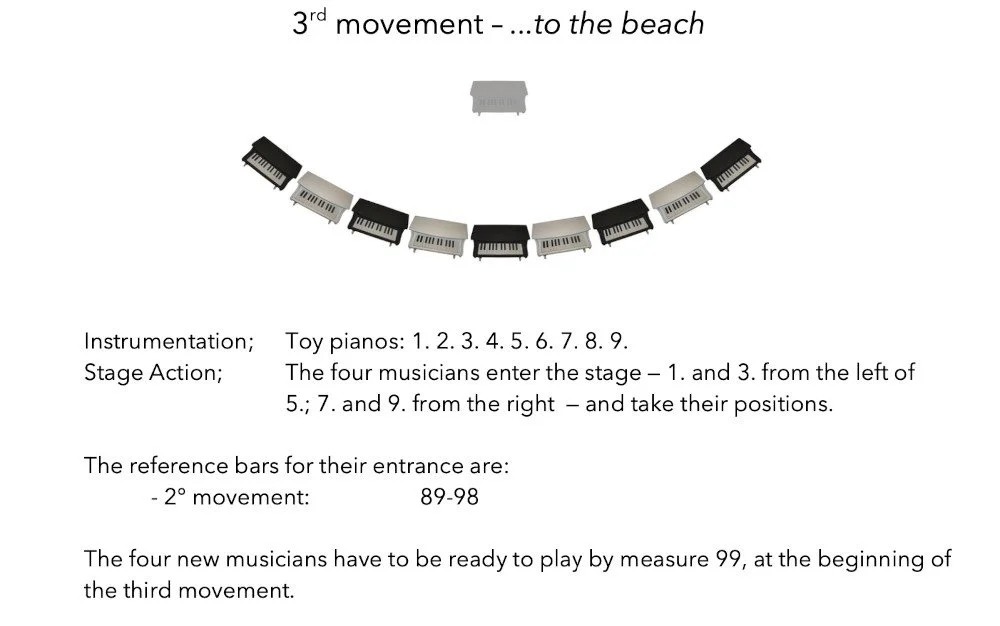
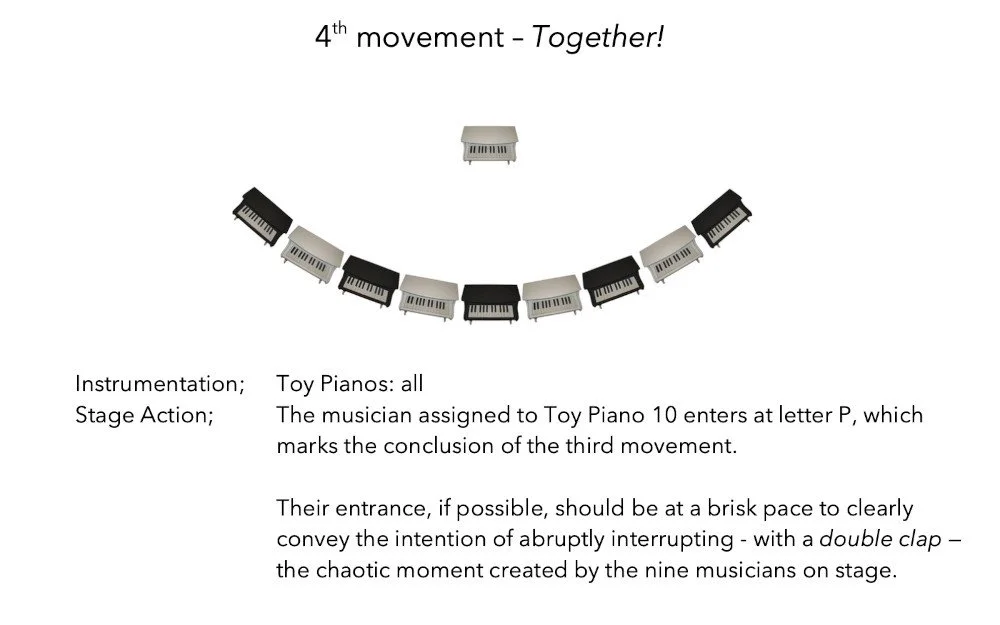
International Debut: Toy Piano World Summit, Luxembourg
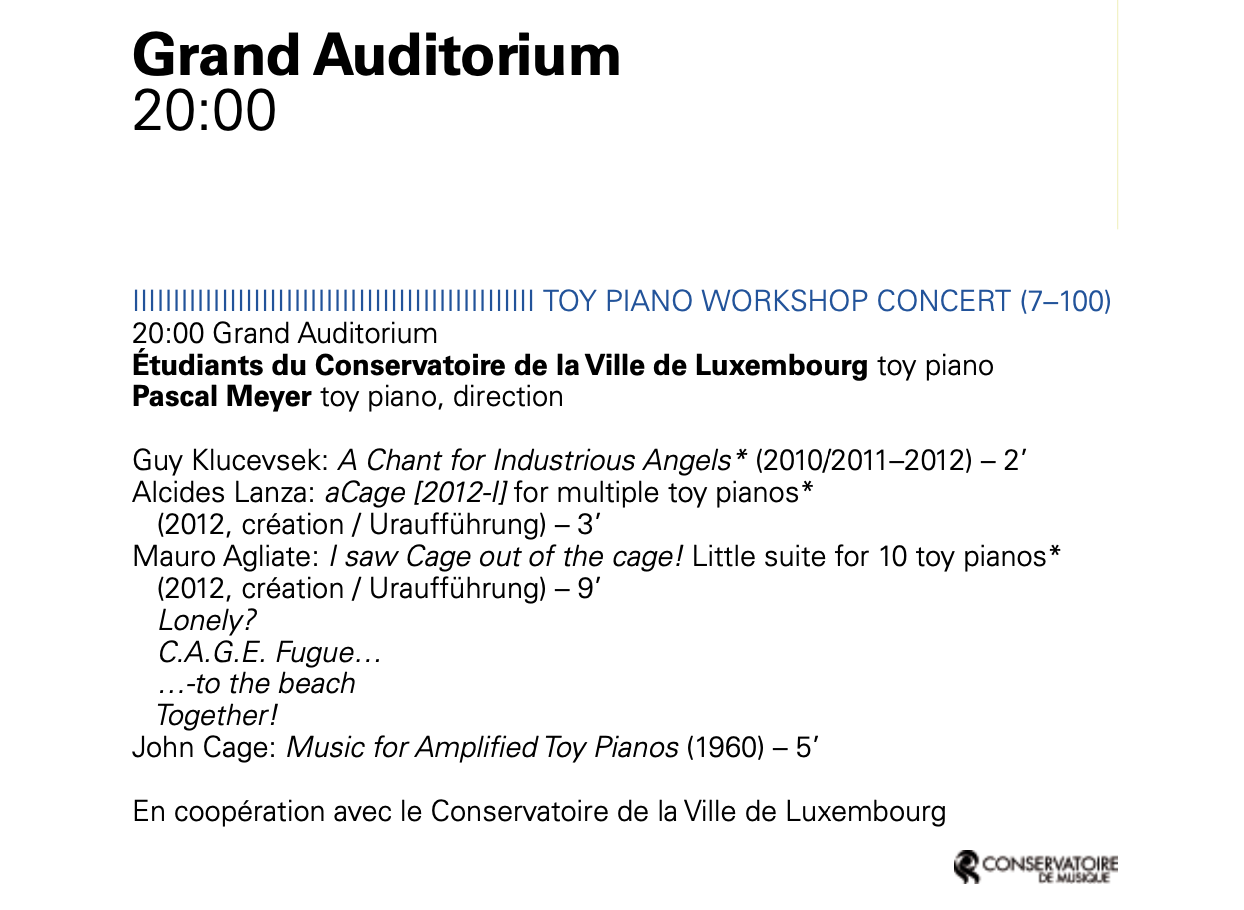
Selected from numerous international scores, the piece was performed during the prestigious "Toy Piano World Summit" in December 2012 at the Philharmonie Luxembourg (Rainy Days Festival).
The event, titled "The Big John Cage Extravaganza," celebrated the centenary of Cage's birth. This world premiere proved that the toy piano could successfully carry the weight of a complex structure on a world-class stage, moving the instrument from the realm of play into the halls of great contemporary orchestral architecture.

Across the Ocean: Academic Research and Brazilian Debut
The suite's journey reached a significant academic milestone at the 9th International Meeting of Contemporary Piano (UFPB) in João Pessoa, Brazil.
Here, the project was presented both as a concert work and as a subject of Oral Communication of Research. In 2025, during the first "Toy Piano Brazil Show," the project highlighted a consistent compositional path exploring the boundary between play, mathematics, and formal rigor, ideally connecting Turin, Europe, and the heart of South American musical research.