Dies Kunst der Fuga (The Art of Fugue)
A Year of Fidelity to Johann Sebastian Bach
From the microscopic analysis of Contrapunctus XIV to silence as a compositional practice
The Architect of the Absolute: Why Bach
To speak of Bach is not to add information to an already vast ocean, but to declare an allegiance.
For me, Bach represents the perfect convergence between the most extreme mathematical rigor and the deepest expression of the human soul. His music is not merely sonic architecture; it is a living organism where every note is necessary. I admire his ability to have pushed the Fugue to heights that remain, even today, the ultimate boundary of compositional possibility, managing to transmit a sense of the sacred that transcends time and space.
The 2026 Journey: One Note at a Time
This project stems from a radical choice: to dedicate an entire year to a daily "communion" with Bach’s work.
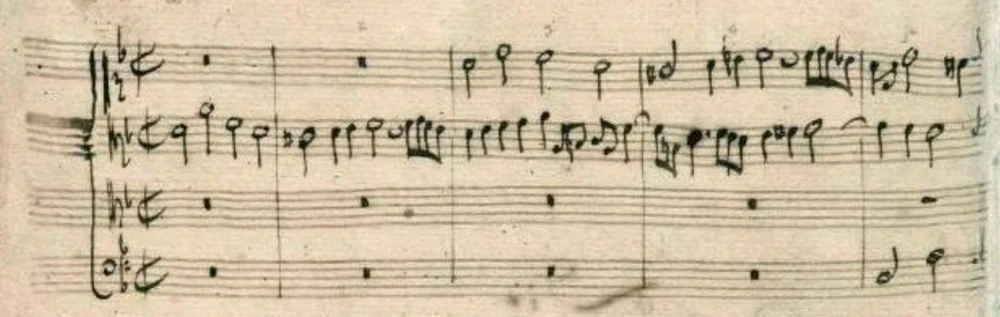
It is not an academic study aimed at publication, but an act of fidelity. Every day, I reserve a space for analyzing, transcribing, or simply pausing over a single bar. At the heart of this path stands The Art of Fugue, and specifically its tragic and sublime apex: the celebrated unfinished fugue.
To inhabit this incompleteness is not to seek to "complete" it—an act that would be as presumptuous as it is likely futile—but to explore its voids, the pressures, and the energetic directions that those notes continue to release after centuries. It is an exercise in patience and admiration: 2,620 notes that become 2,620 hours of shared life, where the unit of measurement is not the speed of production, but the quality of presence alongside the Master.
The Method: Living in Counterpoint in Three Phases
The project does not aim to "conclude" Bach's work, but rather to engage with it daily and rigorously. I have structured this year of fidelity through three distinct moments, which transform technical analysis into a life experience: a slow exploration of the text, a necessary period of silence, and a possible creative return.
Phase I: The Crossing (Analysis and Transcription)
In this first phase, lasting approximately nine months, the unit of measurement is the single note.
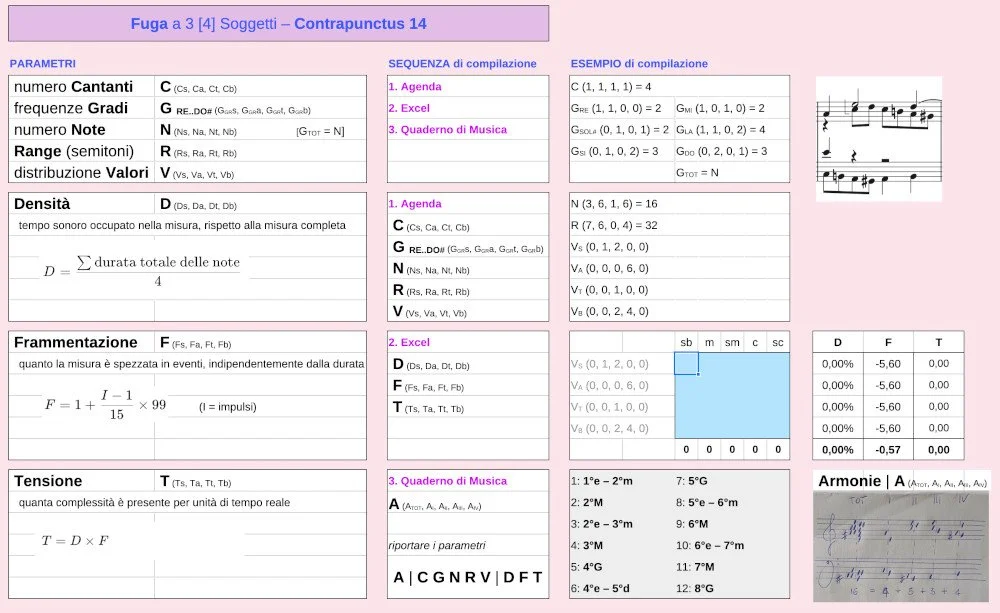
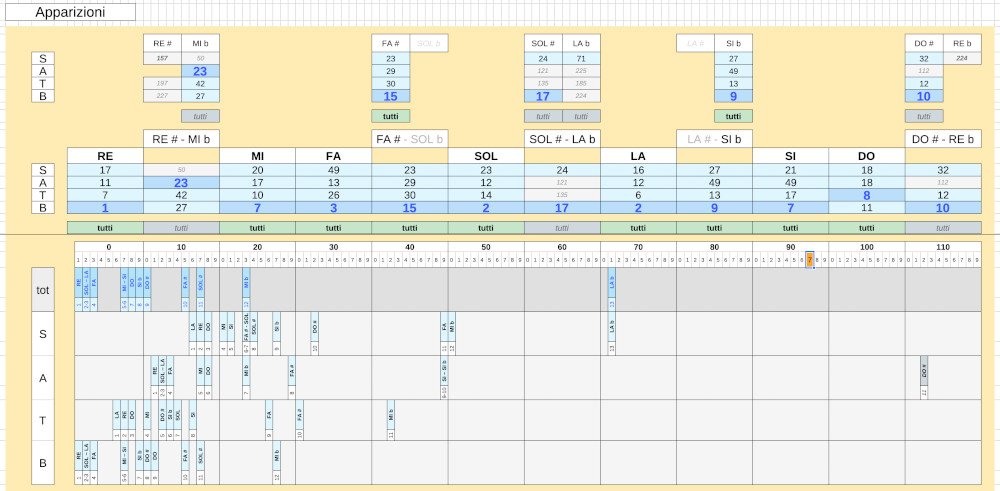
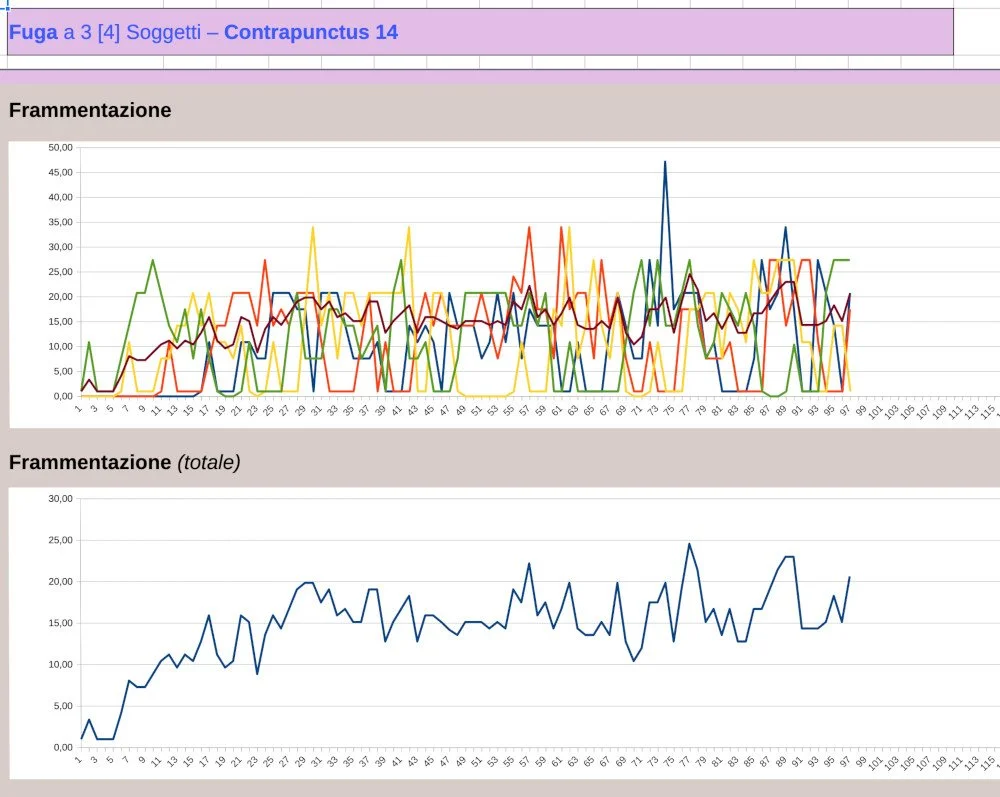
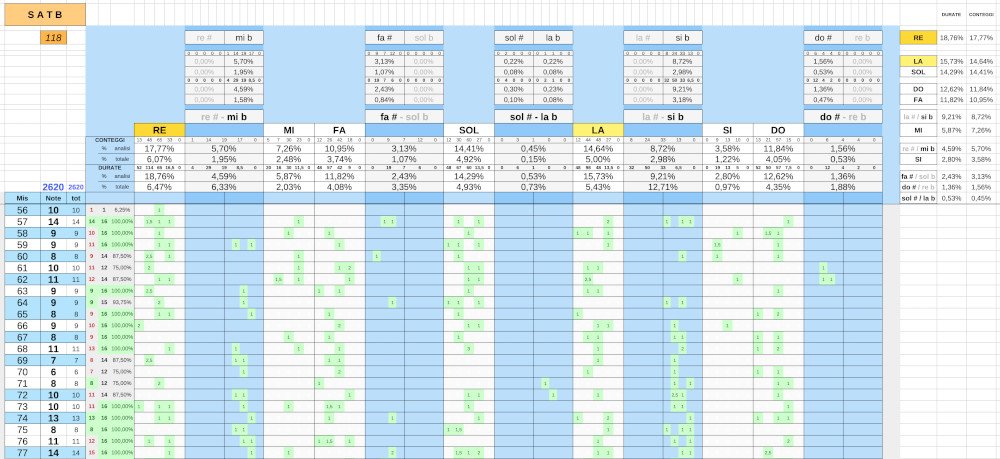
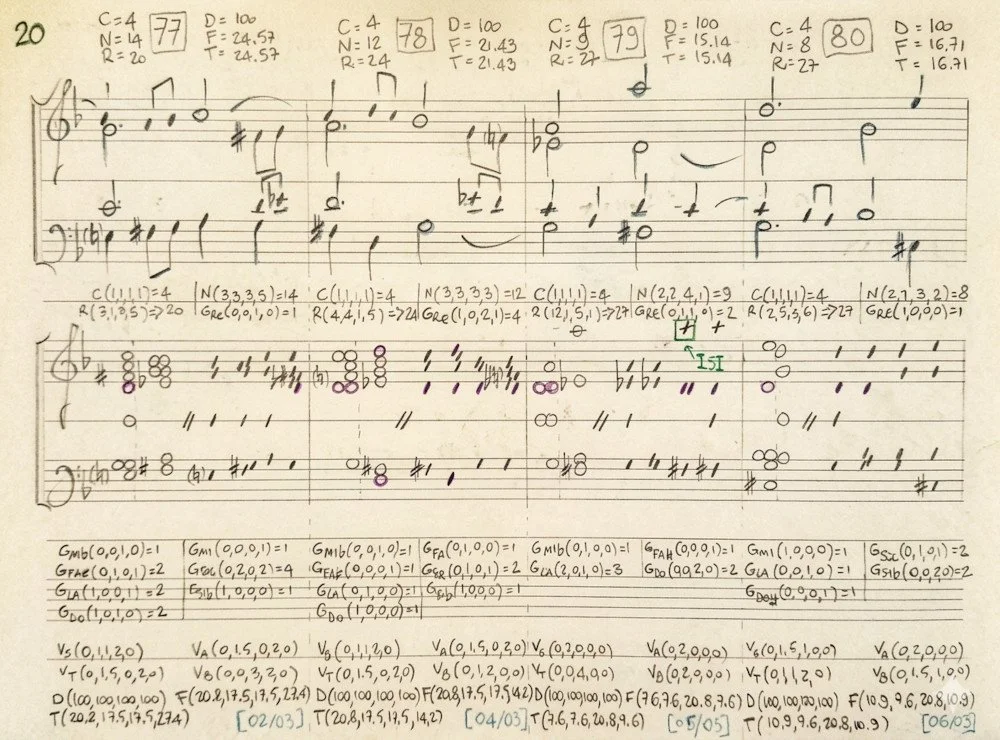
Each day is dedicated to mapping Contrapunctus XIV, weighing every sonic event not as a simple pitch, but as a vector of force. I use statistical analysis and graphic visualizations to observe the density of subjects and the tensions accumulating in the manuscript.
Phase II: Real Silence
Following total immersion in the counterpoint, a phase of suspension will follow.
Silence is not an absence of work, but an act of deferred listening. In this period, the analyzed material must settle without any productive pressure. It is a moment of recollection, voluntarily giving up "speaking" to let what remains of Bach emerge once the score is closed.
Phase III: The Return (The Tonal Shadow)
Only if time makes it inevitable, a reworking may spring from the silence of Phase II.
The goal is not to finish what Bach left interrupted, but to project the relationships of force identified in the analysis into a new form—a "tonal shadow": a composition reduced to the essential that preserves the temporal distributions, rarefactions, and specific weight of the original.